IWI strategies - information, warning and intervention
IWI strategies have defined detailed use cases, based on target scenarios defined in the sub-projects SECONDS, INCA, and EMIC. Here, the definition of requirements for IWI strategies based on use cases have been set and an iterative design, prototyping, and user testing of IWI strategies based on the initial requirements have been developed.
In the sub-project "IWI strategies" the theatre technique was used to carry preliminary evaluations before rapid prototypes were built in software and tested in more sophisticated environments. Different options for IWI strategies can be emulated and assessed in simpler simulators and mock-ups. The theatre technique was a technique where a second person (the so called confederate) next to the driver can emulate the assistance system/automation while being haptically linked with the driver (i.e. by double command). The confederate, representing the active system, can present e.g. an active steering intervention or a deceleration etc via double command which is then directly perceived by the subject.
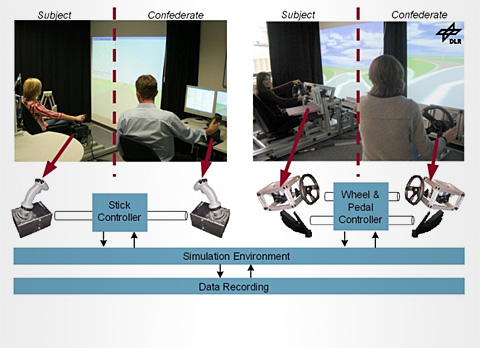
The video shows typical scenes and situations from a simulator study of driver behaviour. It was recorded during a study at the German Aerospace Center (DLR) in 2011.
Update 3.0 (March 2012)
Joint strategies, concepts and designs of IWI
The final interactIVe information, warning and intervention (IWI) strategies have been developed and documented in Deliverable D3.2. The strategies refer to how, when and where driver information, warnings, and interventions should be activated. They represent a set of guidelines and recommendations for the targeted interactIVe demonstrator vehicles. The goal was to achieve compatibility between driver and automation as well as a coherent, integrated and efficient driver-vehicle interaction design. The IWI strategies are structured according to the following strategy aspects:
- Layer of driving task
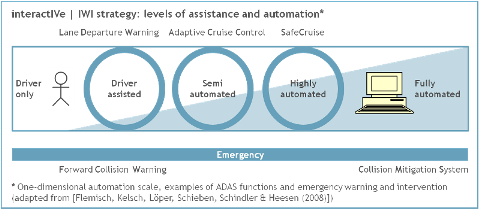
- Level of assistance and automation
- Situation awareness, mental model, mental workload, trust
- Range of operation and availability
- Communication channel
- Sequence of interaction
- States, modes and mode transitions
- Communicate system status
- Arbitration
- Prioritisation and scheduling
- Adaptivity and adaptability.
Apart from developing strategies, different con�cepts and tools were introduced and discussed. Additionally, a comprehensive framework for a idealgraphic layout of the vehicle cockpit visual HMI including detailed design drafts for the various visual and acoustic elements was developed. All the IWI strategies, design concepts and tools, and the visual and acoustic elements were applied to the various interactIVe demonstrator vehicles. As a result, the demonstrator vehicles feature individual manufacturer-specific design details while sharing the same underlying strategies, concepts and basic elements of the interaction design.
Update 2.0 (May 2012)
During the last period, the sub-project �Information, warning and intervention strategies (IWI)� focused on experimental studies. Research questions were collected based on literature search performed during the initial design of IWI strategies as well as through ongoing discussions with project members in the vertical sub-projects in interactIVe.
The following list provides examples of the research questions to create experimental studies:
- �How to decide to which side to do the evasive manoeuvre so that it fits with the driver's preference?�
- �How can the driver, in an unavoidable accident, be encouraged to steer or brake?
- �How does the steering torque overlay need to be designed? Should there be a steering recommendation?�
Seven experimental studies in simulator environments were conducted through April 2012 at Volvo Technology, German Aerospace Centre, Fiat Research Centre, and at Allround Team:
- Volvo Technology - study I: Rear End Collision Avoidance. Driver reactions to an active steering intervention to avoid a rear end collision.
- German Aerospace Centre - study I: Collision Mitigation System by steering in a critical intersection scenario.
- Fiat Research Centre - study I: Continuous Support (information, warning, no intervention). Comparison of warnings with different modalities (auditory, visual, haptic via steering wheel, accelerator pedal, seat belt) for different lateral and longitudinal threats.
- Volvo Technology - study II: Evaluation of Side Impact Avoidance and Run Off Road systems by steering intervention.
- Allround Team - study I: Different types of pedal haptics for different scenarios: curve speed, forward collision, speed limit warning.
- German Aerospace Centre � study II: Rear End Collision Avoidance by steering interventions. Evaluation of sequence of warnings and interventions and design of steering recommendation.
- Fiat Research Centre - study II: Continuous Support. Assessing warning modalities in multiple threats situations.
In addition to the above experiments, Ford Research Centre Aachen and Volvo Cars have performed two test track experiments with some involvement from the sub-project IWI strategies:
- Ford Research Centre in cooperation with Allround Team: Drivers� brake and steering behaviour evaluated in relation to a stationary object on test track. Vehicle capacity compared to drivers� preferred actions.
- Volvo Cars in cooperation with Volvo Technology: Rear End Collision Avoidance evaluation with brake pulse on test track: Traditional Head Up Display (HUD) and sound compared with HUD, sound and brake pulse.
Interview with human factors specialist Emma Johansson, Volvo Technology (July 2011)
Improvement of dicision strategies for active safety and driver-vehicle-interaction was one of the distinctive missions of interactIVe. In an interview human factors specialist Emma Johansson provided an insight into the ongoing research.
What is your specific task in interactIVe and what is your research approach?
Emma Johansson: It is our task to investigate IWI strategies for Advanced Driver Assistance Systems (ADAS). This task is performed in close cooperation with the application-oriented sub-projects. The partners involved are Volvo Technology, Centro Ricerche Fiat, Allround Team and the German National Research Centre for Aeronautics and Space (DLR).
Our research question is: How do we create a support system with well-integrated functions which is affordable and accepted by the driver? In short, IWI strategies should cover an array of interaction modes, i.e. visual, auditory and haptic output/input. We aim at assisting the driver with steering, braking and acceleration interventions in emergency cases, but also at providing him with relevant unobtrusive information.
How is research conducted?
Emma Johansson: We work with available standards, guidelines, recent literature findings, and experimental studies. Testing is needed when we are looking for new IWI strategies for specific functions or when we have to validate existing strategies. The first set of experimental studies is currently in the preparation phase. We aim at executing nine experimental studies with approximately 200 test persons. We will use several testing facilities:
Two fixed-based driving simulators from the partners Allround Team and DLR for passenger cars and one truck driving simulator at Volvo Technology, all with dynamical traffic and environment simulation. In all three simulators we are able to adjust traffic dynamically and create any environmental condition like snow. Also, we will use two moving-based driving simulators from Fiat and DLR, and one test vehicle from DLR with full drive by wire capability.
We also have to implement new software and hardware into the simulators. We expect our first results in fall 2011.
What is the particular challenge of your work on IWI strategies in interactIVe?
Emma Johansson: If warnings are unsuitable and the intervention is not according to the driver�s expectations of how a situation will evolve, this might lead to that the driver simply shuts the system off or performs counteractions possibly resulting in an even worse situation.
Functions should easily be understood and operated intuitively by the driver. They should give the optimal benefit and support in order for the driver to drive safely and they should not counteract against the driver�s intentions. All functions should be controllable by the driver at any time, be well integrated into the overall vehicle interface with as few modes and abilities as possible and with consistent semantics for warnings and intervention.
The interview was conducted by EICT.
 structure
 perception
 IWI strategies



by the European Commission